
“The fact that the powerful often win
does not mean that a war isn't going on".
—Tricia Rose, Black Noise
“Heaven’s blue flame laps the goat up.”
— I. S. Jones, “After the Offering Ritual, Cain Carries Abel Home”
It is now commonplace on the Internet, as it had already been in many of our lives, to hear (or read) it proclaimed that a given creator (musician, producer, etc.) has “put crack” into their sonic creation. Like all good language that manages to be both effective and affecting, the saying is habit-forming. That it captures the best hyperbolic drama of speechplay is seductive and unnerving. Equal parts, metaphorical and callous, the phrase floats with wit, but in its new digital home often chokes ever so slightly on its misappropriated flippance, that all too enthusiastic suggestion that the crack epidemic and its blackened casualties be invoked only for the sake of scripting the transformation of desire into hunger, a need not only for the substance of a creation but for its repetition, that all-consuming alliteration of want which connotes addiction.
With such slippery associations at play, I am reluctant to use the phrase to describe the circularity and virality of Atlanta born singer -songwriter Mariah the Scientist’s latest single, “Burning Blue,” though I remain in its grip. And as it turns out, I am not the only one playing it on repeat. The song, which precedes the artist’s forthcoming album, Hearts Sold Separately, is a buoyant ballad that rose to #1 at Apple Music after its release on May 14th and continues to enjoy unprecedented success, including media forecasts of 2026 Grammy nominations.
The R&B bop continues to move up the Billboard Hot 100 charts, bringing its creator greater visibility for her craft. A singular experiment in lyricism, “Burning Blue” has only one writer listed in its credits, Mariah Amani Buckles, also known as Mariah the Scientist. According to the lore, Buckles adopted the nom d'artiste “Mariah the Scientist” after attending St. John’s University in New York City on a biology scholarship. And though she dropped out of school, swapping out the bio lab for the studio booth some years ago, she is often subject to peer-review and inquiry. Save for Pitchfork reviews, the media analysis of Mariah the Scientist has not been very focused on her music. Considered most often as a pop culture specimen, on account of her spectacled and oft-derided fidelity to boyfriend and musical collaborator, rapper Young Thug, who was recently released from prison following a high-profile RICO case, Mariah the Scientist is readily dissected for her intimate life rather than her songwriting. But with “Burning Blue,” a dreamy love song that begs for a line dance, the Scientist makes her mark on the mainstream with a R&B track that has compelled many to devotion. And like a true devotee, I am nothing if not studious.
“Burning Blue” begins with a diagnosis. “I got that blue fever. Cold as ice til you came near,” Mariah the Scientist sings. “You’re like another fire breathing creature,” she croons, classifying her lover in a taxonomy of mythical creatures. Then she troubles her observation. Though her lover may breathe fire, all fires are not fungible. “But it don’t burn how it appear,” she explains. What follows is a series of warnings and reports. Yes, the subject has made her melt but she remains liable to freeze if the conditions do not suit warmth. “But don't you forget it, if the person you fell for ever do, freezes, it’s only because you ain't here.” The familiar metaphors of hot and cold emerge in the mind. But then the sensations take hold and authority, commanding the body to appear. “I can feel it in the air. My cold sweat, dripping everywhere.” We stand at attention.
Upon first listen, the lyrics of “Burning Blue” bit me like a pair of false fangs, piercing the mind rather than the flesh. As a songwriter, Mariah the Scientist has been critiqued for her allegedly saccharine sentimentality, a poetics so sweet and self evident it could rot teeth. In his review of her 2023 album To Be Eaten Alive, Pitchfork writer Jackson Howard renewed assessments of the artist’s “famously raw and diaristic lyrics, which, at their worst, tip into the maudlin—the stuff of high-school journals and Tumblr art.” Curiously, even the critic cannot deny the power of the Scientist’s pen. “Still, when Mariah’s writing does work, […] her poetic vulnerability stuns,” Howard concedes. Comparing her to her contemporaries, Howard classifies her apart from “the disaffected tragedy of Summer Walker or the gut-punch neuroses of SZA.” The Scientist, in Howard’s classification, shares with this R&B contingent the knowledge of “how to pick apart the remains of a failed relationship with scavenger-like precision,” but her lyricism is far from autobiographical, marking a distinction from her cohort. For Howard and other listeners, the Scientist’s “impersonal takes on distant love” seem to contrast the drama of raw material surrounding her personal life. “The strain of maintaining their bond during Thug’s incarceration could, in theory, make for compelling songwriting material, more so than simply being scorned. Instead, she sounds bored and uninspired, too exhausted by her circumstances to jolt herself awake,” Howard suggests.
In evading autobiographical capture, that impossible demand and threshold for “truthfulness” which regenerates in assessments of Black writing since the slave narrative, the Scientist extracts the teeth of authenticity. Her prosthetic poetics make an art of masking the toothless cavity of interiority. Where SZA successfully crafts lyrics that float with the dynamism of authenticity and fabrication, it is, what Alexander Weheliye calls the “extralinguistic dimension” of her singing which conveys the depth of intimacy’s incoherence in her discography. SZA’s music thus pulls us in like a siren song, and announces the pleasures of listening, in the words of Weheliye, “not to experience pop music lyrics as content transmissions but as textural frequencies of nonwordness.” In this vein, Mariah the Scientist, takes shape as a siren of a different sort. Continually redrawing the boundaries of what she will not concede in battle, the Scientist sings of transparency and opacity. She does not call her love closer so much as she holds him in place with her devotion. This siren lures transient lovers to the doom of definition. Leaving them stranded in the sea of love, the Scientist follows the methods of her discipline, calculating the distance and difference between two organisms. Each song, a controlled experiment,“Burning Blue” is among her most critically acclaimed studies.
“Is Mariah the Scientist a Creative Genius?” reads the thumbnail on the 1-hour YouTube video of Mariah the Scientist’s interview with Aria Hughes for the Complex explainer show fittingly named “Please Explain.” In the interview, the Scientist admits having reviewed a few of the fan theories without outright affirming them. “I feel like people sometimes over process a song and what they like want it to be, which is fine though. I feel like that’s what it’s about. It’s open to interpretation.” The interviewer, in an effort to convey her understanding of the track, turns to the cosmic and contested science of astrology, emphasizing that she, like the Scientist, is a Scorpio and reads the song through the lens of the fixed water sign.
Admittedly, as a reformed astrology girl myself, I was not immediately put off when the interviewer redirected our attention to the stars. I can handle a bit of celestial banter. And at a time when Scorpio singer-songwriter SZA, a 2024 Songwriter Hall of Fame inductee and Hal David Starlight Award recipient, is increasingly regarded as “One of This Generation's Best Songwriters,” the interviewer’s invocation of astrology brought to mind the Mars-ruled state of the current R&B landscape in which women with prominent Scorpio and Aries placements have been dominating the game. Still, Hughes’s astrological reading of the lyrics was fairly superficial, not the product of a discreet Scorpio insight but rather, a general willingness to “get metaphorical” with the Scientist. “It sounded to me like you were saying, sometimes I can be ice cold but when I'm around someone I love, I melt,” Hughes explained.
In the months since the track’s release, fans of “Burning Blue” have worked to decode the lyrics on social media, offering complex close readings about fiery passion and the science of combustion, the chromatic spectrum in which the blue fame is the hottest of them all. Interviews with the artist in the wake of the hit song have inquired about the Scientist’s formula for creating the chart-climbing sonic concoction. If not crack, then what?? To quote the enigmatic hitmaker, one Amala Ratna Zandile Dlamini, more commonly known as Doja Cat, we ask, “Is it coke? Is it crack? Is it meth? What the fuck do she put in them hits?” With “Burning Blue” we see the questions yet again. The close-reading canines are out in full force.
This manhunt for meaning brought to mind a tweet from the writer and professor Lauren Michelle Jackson. Quote tweeting a post which proclaimed incredulously, “Are they not teaching symbolism, metaphors, hyperbole, nuance and inference in schools anymore????” Jackson responded with the following:
“the issue is too much symbol hunting, really; "easter eggs" &c. marvel & swift have a hand in this, though ultimately we don't teach reading anymore. audiences lack the language the describe aesthetic objects on their face & arguments over what is not there suffices for ‘depth.’”
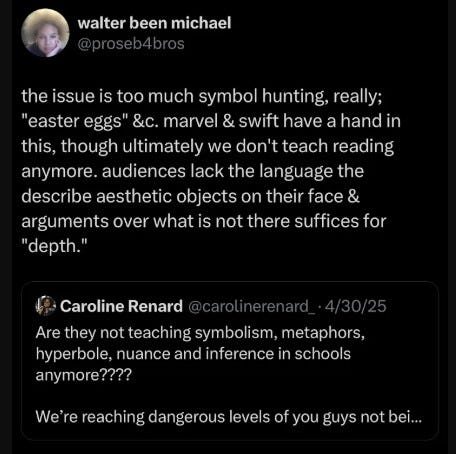
The tweet teased the critique laid out in her then-forthcoming essay for the New Yorker, “Drake, Kendrick Lamar, and Our Moment of Bad Reading,” which was published a little over a week after the Twitter/X post. In the essay, Jackson brings our attention to the growing cultural dependency on decoding. “The once-upon-a-time defense of the poetics of rap has been ceded to the millennial mind of genius.com, taking every syllable as ripe for mundane exegesis,” writes Jackson.
Though Jackson’s essay takes up the diss track—a distinctive genre “made for parsing,” a classification for which “Burning Blue” does not qualify, her provocation that, “If hyper-focusing on lyrics is the assignment, how about some with real teeth?” reverberates. Striking a necessary blow at the “dissected grievances of pop stars and the willful misreading of the moment’s meaningful idioms,” Jackson redirects our attention to the ways these antics serve to mute desires and calls for something more than celebrity, something more than the incessant cultural noise that filters and fades out the screams and silences of a nation whose most consistent anthem is that of empire: war-mongering, fascism, dispossession and censorship. In the case of Black popular music, the issue of celebrity noise pollution and toothless lyricism is also caught up in broader concerns about the complicities of cultural production. The desire for the severance of Black popular music’s troubled conjoinment with what Matthew Morrison calls “blacksound”— that “sonic and aesthetic complement to blackface minstrelsy” on which America’s commercial music industry was founded—endures, and remains unmet. To be sure “Burning Blue” is neither a diss track nor a song for revolution but it is perhaps a sonic flare, an instrument illuminating the state of intimate affairs which prove political.
Where the Scientist is concerned, politics follow the issue of taxonomy. Toward the end of her interview with Hughes, Mariah is made to revisit a previous controversy from a 2023 Complex interview in which perspectives about the classification of genre proved to be inextricable from the classification of race. “If you black and you sing, they sayin’ it’s R&B, and that’s just not true,” Mariah the Scientist remarked. She is not the only one of her musical cohort to share this hypothesis. From R&B to Afrobeats, young Black artists throughout the diaspora have been increasingly passionate about distinguishing the Negro from her forms, liberating the Black artist from “Black art.” For Mariah and numerous other R&B millennials and Gen Zers—SZA, Frank Ocean, —the industry’s classification of music is the work of the racialist, not the artist. If only we could, as Briana Younger writes, “listen with our ears, not our eyes,” then we might be free.
For many, even with eyes closed, the Black artist’s rhetorical exodus from R&B rings like a dog whistle of the intraracial variety. What breaks the sound barrier then is a more troubling note: the question of whether a rejection of racialized forms is necessarily a gesture toward racial distinction. The heated genre discourse even led the Scientist to catch a more personal stray, the exhumation of a discourse once pronounced dead—that of the Scientist’s own racial classification, a topic which recurs, to her dismay, in her early interviews where she expresses frustration at her misclassification as “mixed” and/or “biracial.” As this resurfacing suggests, for many, matters of genre classification contain the stakes of classifying race itself. The words of literary scholar Hortense Spillers in her underread essay “Mama’s Baby, Papa’s, Too” resonate:
“We very much doubt that the fury here is that there are not enough boxes on the census form, or a deficit of classificatory items, or the prohibition to check more than one, or even the thwarted desire to express racial pride, but, rather, the dictates of a muted self-interest that wishes to carve its own material and political successes out of another’s hide.”
To apply Spiller’s critique of self-interest to R&B then, I am inclined to regard the genre wars as nothing more than a restaging of the anti-Black drama of the census and its burlesque of racial self-reportage. An artist’s willingness to choose or reject R&B amounts to two heads on the same beast—a hydra that feeds on the spectacle of racial affirmation and identification. We know there are casualties in both camps. Individual and collective efforts to, as Jared Sexton puts it, “distance oneself from blackness in valorization of minor differences that bring one closer to health, life, or sociality,” devastate through the promise of deliverance but are not the true source of devastation. After all, even affirmation becomes an opiate under these conditions. When flight and flattery fail to change the tides, we are called to defamiliarize ourselves with the terms of order.
For Mariah the Scientist at least, the issue is presented in philosophical terms. “What really defines R&B? What does it mean?” she asked during her 2023 Complex interview. Feeling vindicated in her 2025 conversation with Hughes, Mariah the Scientist shouts out the success and symbolism of Beyoncé’s Cowboy Carter, the latest strike on the frontlines of the genre war. On the album, Beyoncé, herself an R&B star who is now emblematic of American popular music writ large, describes ‘genre’ as a “code word to keep us in our place as artists.” This decoding holds true in cases where musical and rhetorical flights for freedom from genre are met with what Koritha Mitchell calls ”know your place aggression.” The audience’s sinister refusal to shimmy at the CMAs during Beyoncé’s 2016 performance, comes to mind. But this cartoonishly anti-Black resistance to “genre-bending” springs from a different source than those who chafe at the repeated assertions that it is R&B which is “restrictive” to Black artists, rather than, say, anti-Blackness itself. If “genres are a funny little concept,” then perhaps it is fair to say that the joke is on us. That the genre war quacks like a race war is old news. As philosopher Sylvia Wynter teaches, Man, too, is a “genre.” And in the case of Blackness, inclusion or exclusion in the genre of Man has proven particularly fraught. The breach between “knowing your history” and “knowing your place” then is a chasm eroded by interests that flow from all sides.
In this stream of doubled consciousnesses, Atlanta R&B girl group TLC’s 1994 caution, “Don't go chasing waterfalls. Please stick to the rivers and the lakes that you're used to,” takes on a new register. The hit song, “Waterfalls,” which lives in history as the first number #1 song to refer to the HIV/AIDS epidemic by name, conjures the waterfalls as a symbol of desire and descent. To “chase waterfalls” is to be caught in the stream, the transmission of risky intimacies and injections. Groundbreaking for its representation of the virus’s capacity to contaminate the imagined purity of heterosexual touch, the music video holds to tradition in renewing the doomed vows of sex and drugs, and the racial stakes therein. In 1995, the music video for “Waterfalls” won Video of the Year at the MTV Music Awards, making them the first African-American act to win in the category.
Carol Vernallis notes the aesthetic codes of purification and segregation in “Waterfalls” in Experiencing Music Video:
“In the chorus of ‘Waterfalls,’ the members of the group stand in the midst of an enormous stream of water and adopt a position of wide distance. The verses, depicting gang violence and AIDS, occur in completely different spaces, in terms of both location and color, and are separated from one another by the chorus’s broad blue expanse. No intermingling of visual materials accords song sections—each section exists in isolation.”

Like columns, the trio, Chili, T-Boz, and Left Eye, stand apart in the “blue expanse” of water and sky. Their solidity makes a state(ment) of matter. The visual language of “Waterfalls” resists contact at all costs. Cautionary and compelling, the sirens of 90s Hip Hop and R&B croon and sway to keep contamination at bay. The performance fits the message. As Jared Sexton contends in Amalgamation Schemes, “AIDS reinvigorates a longstanding premise of antimiscegenation: the fear that sexual contact with black bodies will turn over into violence, that such contact in and of itself constitutes violence, a site of brutality or morbid contamination or both.” Structuring the frame for our picture of purity, the politics of race and gender expose the racialized relationship between contamination and complicity. This is, of course, no revelation in the case of R&B. “Dilution anxieties,” in the words of Margo Natalie Crawford, predominate in talk of Black music as they do of Black people.
As music critic Nelson George asserted in his 1988 book The Death of Rhythm and Blues, “For all its vitality, black music has shown itself quite vulnerable to dilution.” Knowing well that the “fetishism of both purity and mixture overdetermines racial fetishism,” we are called to consider the conditions which produce and constrain the production of Black music beyond paradigms of purity or hybridity. As Alexander Weheliye writes in Feenin’: R&B Music and the Materiality of BlackFem Voices and Technology, “The music, its lyrics, and the cultures around R&B in the contemporary moment are both a response to and a shield against these genocidal conditions, the afterlives and aftershocks of slavery and colonialism.” Taking R&B seriously then requires deeper inquiry into this shielding service of the genre. How does it shield us? Whom does it shield? And what escapes its safeguards? This is especially pressing given the race, gender, and economic terrain of the genre. “R&B is the only musical category where black female performers dominate,” Weheliye explains. At the top of this hierarchy, Black women often sing tales of breach, heartbreak, seduction, love contracts voided by betrayals. Each song, a microscope that magnifies the living dramas obscured by “the generalized heartbreak of Black life.” Fidelity to and in such a genre is an organism subject to study. What then could define fidelity in/to R&B? What does it mean?
When in doubt, pledge allegiance. Taking up the metaphor of militancy, the music video for “Burning Blue,” directed by Claire Bishara, offers a picture of fidelity structured by the firm directives and formations of military drill and ceremony. In a blue flight cap and a cropped white button down, Mariah appears in a severe bob with the confidence of a leader. As she sings, soldiers gyrate, body-rolling with their rifles. Reminiscent of classic R&B’ music videos in which the instructive and imaginative capacities of choreography were on full display, Mariah the Scientist illustrates her war drama through movement. Following her cues, the dancers enact the drills of devotion with fluidity and form. Though she is surrounded on all sides, the Scientist remains untouched. Her orders go unspoken but heeded. “If you open fire, then it’s treason,” Mariah sings on the second verse, putting her lover on notice. “And I’ll decide to go out swinging.” The hybrid form of promise-threats serve as a show of power. “If you shoot then you can bet, every single dollar and your last few cents, that I will too. And I mean it. Tell me where do we go from here?” The dark blues and blacks of the video give the visuals a tinted quality, a palette fit for defense. This is an offering of a love that gushes behind a wall of guardedness. A feast in exchange for forgetting. The erotics of a relinquished retreat. On these terms, the compassing of treason serves as an act of foreplay. The plastic gun turns to steel. Submission is a smooth shank, slaying the beast of an untamed lover, pinned down only in the “you” of lyrical address.
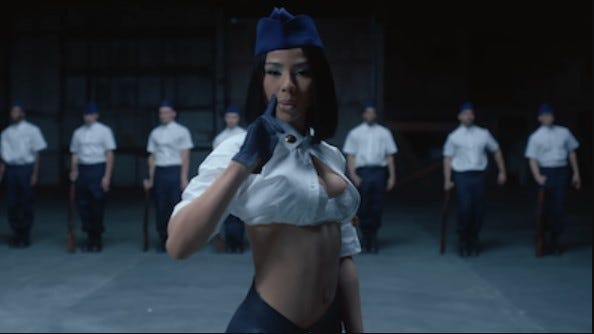
As the Scientist turns her back on the camera, walking away as the track closes out, I felt compelled to start the video over, to watch the smooth precision of performance once more. In time, it became clear to me however that I was also bearing witness to an unfortunate imprecision. In matters of love and war, we must be careful who and what we cling to. This “war on love,” staged in the midst of the cultural war on genre, had in its conceptual and visual codes performed fidelity to the U.S. empire and its aesthetics. As is so often the case, the Scientist is on military contract. The battlefield of love is also a laboratory. Certainly, what Naomi Wolf calls “the military-pop-cultural-complex,” is exemplified. And there is undoubtedly much to be said of what Tom Digby describes as the “complex interplay of gender and militarism.” But even this feels insufficient. In the case of R&B, one must take the classification of complicity a step further. What really defines complicity in R&B? What does it mean when the genre of breach ballads borrows from the empire to produce a ballad that binds?
In “When Malindy Sings: A Meditation on Black Women’s Vocality” Farah Jasmine Griffin considers how American writers, “both black and white,” have constructed “narratives of nation” around Black women's singing.
“Perhaps it makes perfect sense that this black voice in the United States has become the quintessential American voice. It parallels the development of the nation. It is one of its founding sounds, and the singing Black woman one of its founding spectacles. But because it develops alongside and not fully within the nation, it maintains a space for critique and protest.”
To enter this “space of critique and protest,” we are called to consider the contemporary narratives of the nation in which Black women vocally or otherwise speak for and with the State. Less rhetorical than Knowles-Carter, who has formally declared her “reclamation of America,” Mariah the Scientist treats the nation and its military formations as a metaphorical resource.
A few weeks before “Burning Blue” hit streaming platforms, Mariah the Scientist appeared on Over It Radio, the podcast of fellow Atlanta R&B songstress Summer Walker, and revealed that the inspiration for the forthcoming album Hearts Sold Separately, had come from an unexpected source— a “little green toy soldier.” Born of thermoplastic and molded in the shape of military men, these toys signify for the artist the issue of scale and relation. These plastic army men, “small and not taken seriously,” symbolize the dissonance of the soldier’s sacrifice and the toy’s shrunken valor. Putting the toy to new uses, the Scientist has drawn an analogy between the little green soldiers and women, like herself, who she argues have been casualties of the “modern man’s war on love.” Playing with the concept of the plaything, she created the album for the unsung warrior— one who finds herself on the battlefield of love, with plastic for arms and abstractions for ammunition.
In all fairness, the Scientist’s interest in scale is longstanding. Though her previous album, To Be Eaten Alive, found its muse among the animate, taking inspiration from the scorpion, it was similarly shaped by the Scientist’s piqued interest in power differentials. Though scorpions are well known for killing their victims with a venomous sting, this is not the primary image the Scientist asks listeners to consider. Displacing the scorpion as a known and notorious threat to reintroduce the arachnid as an unsuspecting adversary, she invited us to consider our conduct when an opponent’s capacity is incorrectly correlated to their stature. “You might think that because it’s a small animal that it could be easily consumed or something, but not knowing it packs a punch,” she explains in an interview with Apple Music. In a roundabout way, this is what ties the scorpion and the toy soldier together. The Scientist’s unending inquiry into the variability of scale and power in our most intimate experiments. Yet, where the scorpion was a symbol for the foolishly underestimated, the toy soldier is pitifully outgunned.
The recently released album cover for Hearts Sold Separately, features Mariah the Scientist (or rather, her likeness) in toy form, miniature and green, before a sorbet pink backdrop. Posed in gesture of salute, this figurine appears in an unconventional armor, her green bustier and short shorts, a uniform for baddie-combatants on the frontlines in the fight for love. On the back cover, the toy soldier is dismembered. Her combat helmet and appendages lay beside her as if she were carefully disassembled. Drawing inspiration from the commodified diminutive figure of the “little green toy soldier,” the Scientist has turned her attention to the un/serious, uneasy, “deep play of difference” by which enjoyment might also be an act of war. “It's like I'm being dead serious about this love shit. And everybody like laughing at me and thinking this funny this shit not funny,” Mariah the Scientist told Hughes. She isn’t the only one seeking reprieve from dishonor. The hunger for valor and affirmation is all around. We perform fidelity til we’re blue in the face.
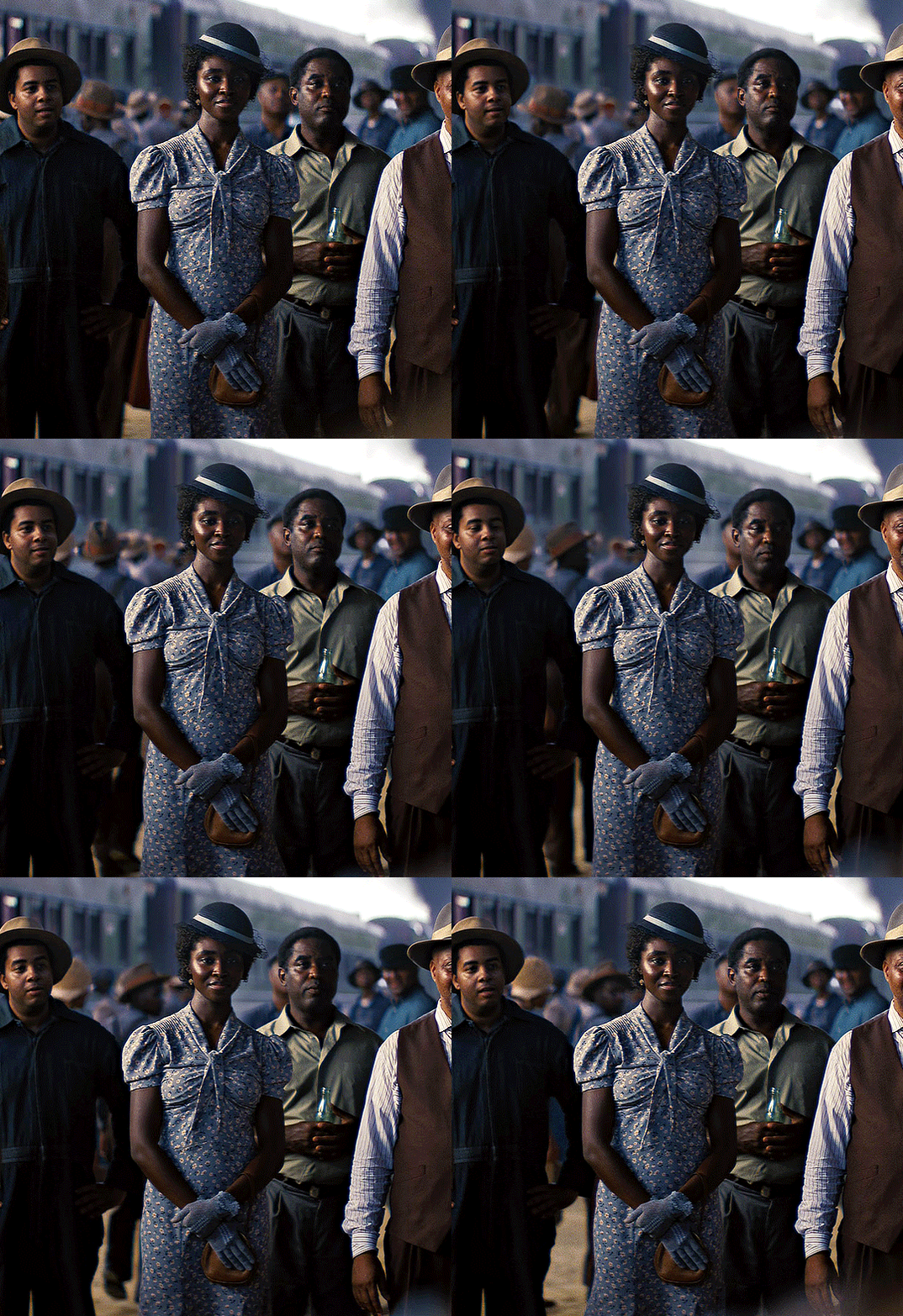
In Ryan Coogler’s 2025 blockbuster vampire thriller, Sinners, the Blues take precedent as the object of affirmation. The forsaken genre is bestowed with ancestral order and the undead privilege that which is and was historically denigrated by the living. Lives are sacrificed to save Sammie, a young blues singer whose voice could marshall the past and the present into procession. Among the sacrifices is a blues woman marked by the shadow of infidelity. Pearline, a self-described married woman, sings the blues with abandon and indulges in indiscreet intimacies with Sammie that mirror the illicit promise of the genre.
In her first appearance on screen, Pearline dons a blue hat, dress, and gloves. The hat, a small planet, dark blue with a light blue ring, sits on her head, tilted with the confidence of pins, a gravity unseen. Her dress sticks to her form like a second skin, hugging her curves and forging new ripples. As she watches Sammie for the first time, she witnesses his Blues but her blues bring him to shore. Her gloved hand, enveloped by a blue netting, separates her hand from his during the introduction.“Careful, boy,” the blue-drapped siren warns the young flirt when he inquires about the quality of her marriage. The warning is overturned by the waves of desire that subsume the burgeoning bluesman in her exit. Even in turning away, she beckons him closer. The blue dress rides the curves of her backside, and Sammie is made a believer. Hers is a mythology upon which fidelity and its opposite dance in unison. She does not wish to be trusted but to be. When the trials begin, she winces at the garlic that could prove her innocence. She gags on the taste of its storied salvation. After she is bitten, she holds to the informal contract of her affair, securing the safety of her temporary lover. In the end, the adulteress earns immortality without aid from vampirism. The Blues cling to her name well after her physical death. Her affairs produce liner notes rather than lovechildren. The hands of time wear the infidel’s blue gloves.
A blue uniform dress is the sartorial signal of color-coded power imbalance between lovers Lena Derriecott King (Ebony Obsidian) and Abram David (Gregg Sulkin) in Tyler Perry’s 2024 Netflix war drama Six-Triple-Eight. Childhood friends turned lovers, Lena and Abram occupy vastly different positions in their 1940s Philadelphia society. Lena, a Black woman, works as a servant at a fancy dinner party where Abram, a white Jewish man is a welcome guest. Her dark blue work dress bears only the white lace trim of a grey apron. Abram dons a bone-white suit jacket and tie. This is, unbeknownst to the young lovers, one of the last times they will see one another.
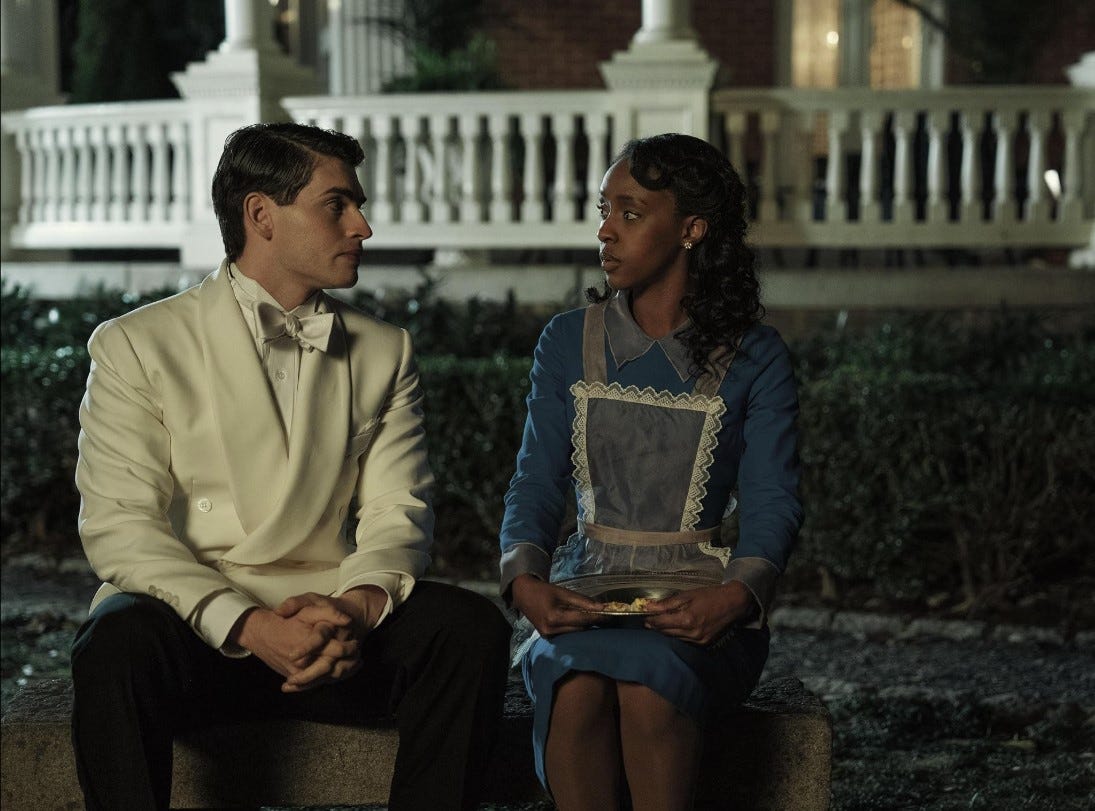
Righteously motivated to join the war effort against the Nazis in WWII, Abram enlists and is killed shortly thereafter. His life and the letters he wrote to Lena are cut off by the war. And Lena, intent on proving her devotion to her lost love, enlists in the military where she and other Black women are placed into the 6888th Central Postal Directory Battalion, an “all-black, all-female battalion” tasked with managing postal services during World War II. When I first sat down and watched the film with my mom, I remember being struck by the opening, a black screen and quote from Mary McLeod Bethune: “We are anxious for you to know that we want to be and insist upon being considered a part of our American democracy, not something apart from it.” I remember how the quote made me anxious. There was a feeling in my gut telling me what was to come—a story of unwavering Black fidelity in the face of terror.
As a unit and as individuals, these women are subject to everything from disrespect to debasement during their service. Based on the true story of the battalion, the film argues for the importance of their previously unrecognized contributions to U.S. military history, in wake of then President Joe Biden's decision to award the women with the Congressional Gold Medal. The task intended to diminish these women is said to restore their honor. The blue fevers of fidelity make love of and to war. No matter how they are treated or what they are called to do, the battalion holds the line with and for love. And curiously, it is the fictional flourish of Lena and Abram’s interracial love story that holds together the promise of the historic project. Lena’s grief for her fallen love and fidelity to the search for his final writings becomes a symbol of the true significance of the battalion's role as the stewards of messages on the war front. Though she may exchange her blue servant’s dress for mute green military attire, her task is unchanged. Endure. Deliver. Keep hope alive.
I have often joked to friends that assessments of Tyler Perry’s canon are often a perfect case study in genre misclassification. “He writes horror films,” I tell them emphatically before laying out my case for Diary of a Mad Black Woman as a “scary movie.” It is not a hard sell. What Perry accomplishes in Six-Triple-Eight is a perfection of the form. Those who doubted his ability to write and direct a war drama were not paying close enough attention. Though the majority of his works concern the dramas of Black women’s domestic and intimate lives, they have always been especially preoccupied with the raced and gendered codes of conduct which circumscribe fidelity under duress, the small wars waged within families and communities in which unity and deference is prized above all. For many, such tales have become one note, but in truth, it is a blue note of the most insidious order. The small deviations flirt with infidelity only to return to form. A similar note emerges beyond the bright blue cover of the award-winning 1619 project, where we are told in writing that “it is [Black Americans] who have been the perfecters of this democracy.” Cast as stewards of the nation's messages in sound and symbolism, the song of Black life is routinely rendered like a R&B hit. Fidelity’s blue notes make earnest agents of the resistance. Perhaps, this uneasy coloring of complicity is a part of what Imani Perry describes in her recent book Black in Blues, as “the mystery of blue and its alchemy in the lives of Black folks.” Blue marks the breach. Blue flames write vows that combust because they cannot cauterize. All experiments run their risks. Fire drills are instructive in this way. Even scientists must be vigilant. Do not leave open flames unattended.